
The Cornell Executive MBA Consulting Club (ECC) is a student-led organization designed to support Executive MBA students interested in consulting careers, advisory roles, and strategic problem solving.
I joined the organization as Chief Marketing Officer and later assumed the role of President. My work focused on building the club's brand presence, establishing a consistent marketing system, and developing programming that connected students with experienced consulting practitioners.
The goal was to create a professional platform within the Cornell EMBA program that would support networking, knowledge sharing, and exposure to consulting as both a career path and a strategic discipline.
The Executive MBA Consulting Club had an established foundation, including strong organizational infrastructure, financial stability, and a committed membership base.
The opportunity was to expand the club's strategic value to Executive MBA students by strengthening its connections to the broader consulting ecosystem. Many students were either experienced operators exploring advisory work or professionals interested in pivoting into consulting roles.
The challenge was to create more structured opportunities for students to engage directly with seasoned consultants — from firms such as McKinsey, Deloitte, and other leading advisory organizations — who could share practical insights into the profession, discuss career pathways, and extend the club's professional network.
This required positioning the club not simply as a student organization, but as a platform that connected experienced executives with practitioners operating at the highest levels of the consulting industry.
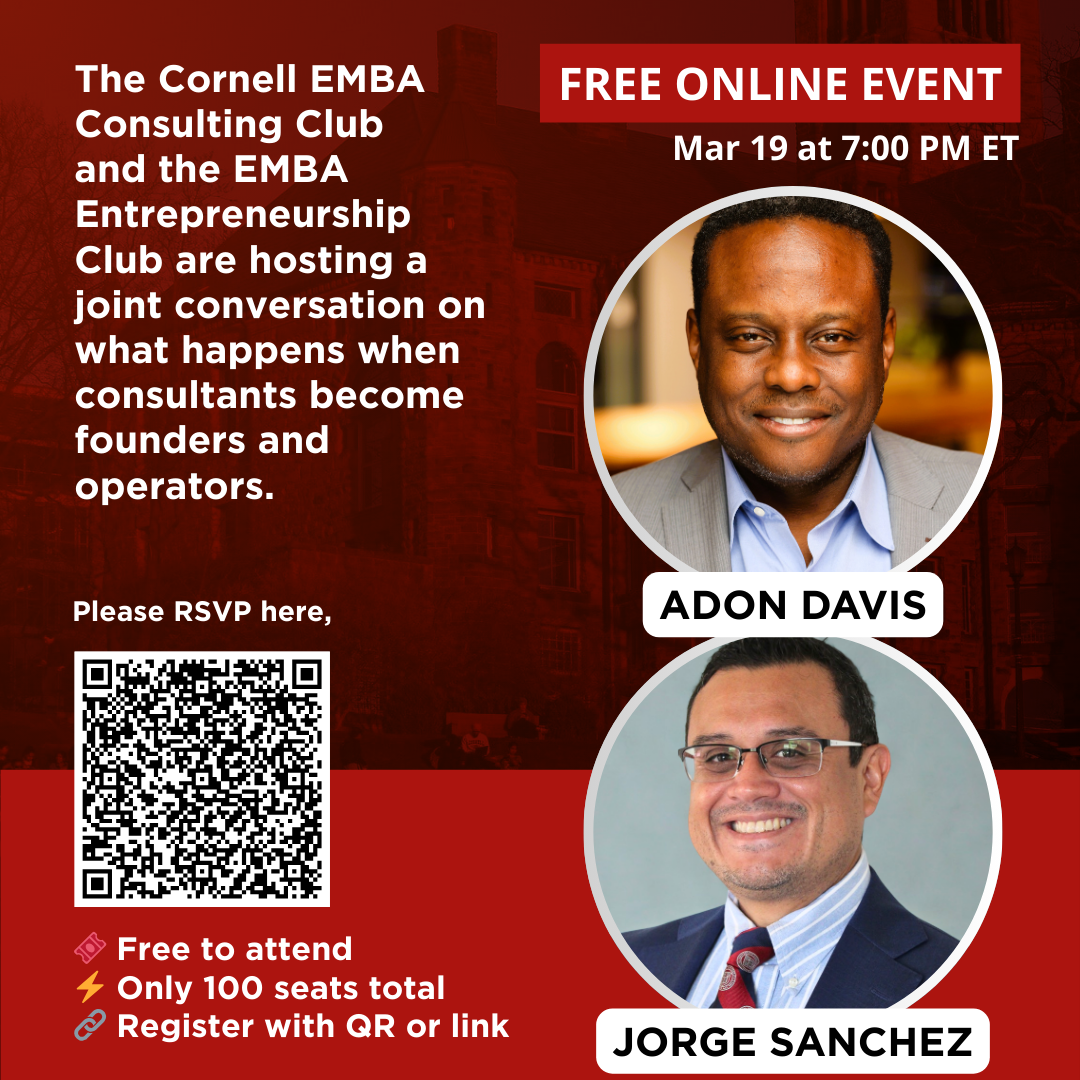

My approach focused on strengthening the club's role as a bridge between Executive MBA students and the consulting industry.
I expanded the club's programming to prioritize direct engagement with experienced consulting professionals, particularly partners and senior practitioners from leading firms such as McKinsey, Deloitte, and other advisory organizations. These sessions were designed to provide practical insight into consulting work, career pathways, and the evolving role of consulting within complex organizations.
At the same time, I developed a more cohesive communications and branding framework for the club. This ensured that events, announcements, and outreach maintained a consistent and professional presence across the program while reinforcing the club's identity as a serious professional network rather than a traditional student organization.
Together, these initiatives positioned the club as a platform where Executive MBA students could engage directly with seasoned consultants, exchange ideas with peers, and build relationships that extended beyond the classroom.
The club evolved into a more visible platform within the Cornell Executive MBA community for engaging with the consulting profession.
Through expanded programming and stronger outreach to industry practitioners, students gained more consistent access to experienced consultants who could share real-world perspectives on consulting work, career paths, and the broader advisory landscape.
The initiatives also strengthened the club's role as a professional network within the program, connecting EMBA students with peers, alumni, and industry practitioners while reinforcing the value of consulting as both a career path and a strategic capability within executive leadership.